


A FEW GOOD MEN Brings Sorkin Back To Broadway — Review

My YouTube algorithm loves nothing more than to routinely offer up, for my viewing pleasure, pivotal courtroom scenes from the 1992 film adaption of A Few Good Men. And I love nothing more than hitting “Play” on every single one:
“The Soldier Breaks, and Confesses.”
“Murder, or Just Following Orders??”
And, of course: “Jack Nicholson’s Legendary Courtroom Outburst!!!”
In all honesty, I’m scared to contemplate how many times I’ve rewatched these legal skirmishes, snippets from director Rob Reiner’s highly watchable film adaptation of Aaron Sorkin’s breakout 1989 play of the same name.
A Few Good Men is early Sorkin, written years before the West Wing creator's name became a genre unto itself. Yet many of the key Sorkin characteristics are already present: rat-a-tat rhythms, rapid fire rejoinders, the struggle for decency in a crooked and amoral world. (Early warning signs of sanctimony and self-righteousness are also detectable, if not yet overpowering.)
But Sorkin’s later talent for crisp, layered characterization (these days, again lost) is not yet so present. So the best way to experience 37-year-old play—and even more so its handsome, old-fashioned film adaptation—is as a tightly constructed, expertly paced legal drama. It is formulaic, sure, but Sorkin works that formula to perfection. Every cross-examination is electrifying; every witness stand confession, a giddy thrill.
Yet for all the strengths of Lincoln Center Theater’s sleek new revival of Sorkin’s military drama, at the Vivian Beaumont through January 10, the biggest letdown is how leaden those same courtroom battles suddenly feel. The scenes are certainly the greatest failing of Michael Arden’s frequently workmanlike staging, which draws out interesting nuances along the edges of Sorkin’s text but fails to animate its core dramatic questions.
The intent of Arden’s production, I think, is to find contemporary relevance in Sorkin’s (not particularly timely) play by drawing out its ideas around the United States military, an institution depicted here as rotting from the inside, choked of any honor by depraved leadership whose obsession with outward displays of might has overwhelmed all sense and morality.
Certainly that is the intriguing approach taken by headlining star Bradley Whitford, a Sorkin regular who inherits the villainous role of Colonel Nathan R. Jessup from screen legend Jack Nicholson. Whitford’s take on Jessup is a far cry from Nicholson’s, who embraced the character’s near-cartoonish wickedness. A stunted Whitford scowls and grunts, and speaks coarsely, but he rarely yells. His Jessup feels closer to an overgrown man child, something almost pathetic to witness—the product of a broken system, rather than an outright monster.
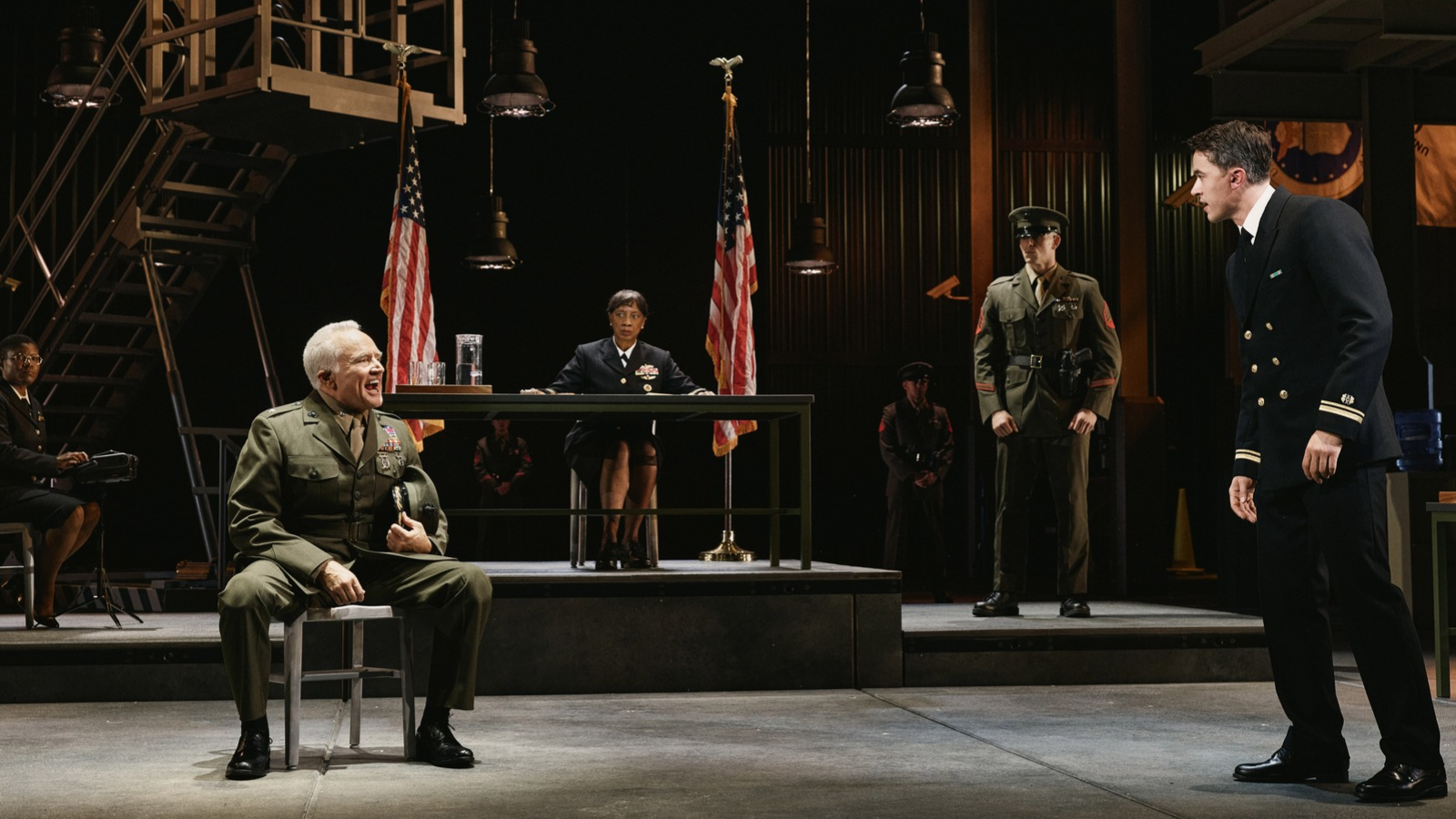
All of the monstrousness is reserved for Jessup’s no. 2 man, First Lieutenant Jonathan James Kendrick, a beastly figure whose mind has been warped by Christian nationalist ideals. Kendrick is the closest the play has to a Hegseth-alike, so Arden naturally zeroes in on him, suggesting the real villain will be found in the next generation of military leadership. John Zdrojeski goes full Sergeant Hartman in the role, and while it is hardly a subtle performance, his work lingers in the mind.
The problem for Arden and company is that, a few intriguing ideas aside, Sorkin’s play isn’t really built for complexity of this manner. It is a David and Goliath story at heart, and efforts at deeper probing aren’t served by a text that, ultimately, is built to entertain.
All that to say: if the courtroom drama flops, the whole thing dies. The play’s second act, spent almost entirely on legal machinations, feels sluggish and listless in Arden’s hands. In the film, Kevin Bacon provided some essential humanity for these scenes as opposing counsel Captain Jack Ross, his warm friendship with our hero, defense counsel Lt. Daniel Kaffee, complicating the proceedings in intriguing ways. But the very talented Michael Oberholtzer is oddly cold in the role, and finds no natural chemistry with lead performer Tom Blyth.
Not that Blyth finds any natural chemistry with anyone on stage. The young star’s talent is without question— excelled as a young Coriolanus Snow in the latest Hunger Games prequel—but Blyth feels miscast in a role played with easy, unforced charm by Tom Cruise on screen. The English actor is, by contrast, a tense and unrelaxing stage presence. One feels the deliberate effort in every word and movement, his stiffness suggesting an actor not yet comfortable on stage—an issue, since Lieutenant Saniel Kaffee is meant to be very, very “at ease,” to a fault.
Elsewhere, a cast of highly capable performers do what they can with what Sorkin has to offer. Krysta Rodriguez is endearingly awkward as the crusading Lieutenant Commander Joanne Galloway, but even with rewrites, the role remains underwritten, and Galloway is sidelined in the second act. Thom Sesma struggles to find depth in Major Markinson, a walking plot device. A steely Lavel Schley can’t reconcile the contradictions of Harold Dawson, one of the accused marines.
But there are highlights; young Colin Kelly-Sordelet is excellent as Louden Downey, the other accused soldier, playing Downey’s guilelessness with a heartbreaking simplicity. And a very funny Nick Blaemiere brings some welcome warmth to the proceedings as Kaffee’s co-counsel Sam Weinberg. The character comes through clearly as the play’s conscience on stage, far more than in Reiner’s film.
A solidly built piece of entertainment, Few Good Men is hardly a tough sit, and looks good on the Vivian Beaumont stage. The suffocating set, by Dane Laffrey, overwhelms its characters in intriguing ways. But the play did not demand to be staged today, and it shows.
A Few Good Men is now in performance at Lincoln Center Theatre. For tickets and more information, visit here.


