


BECKY SHAW: The Irresistible Spikiness of Wrong Matches – Review
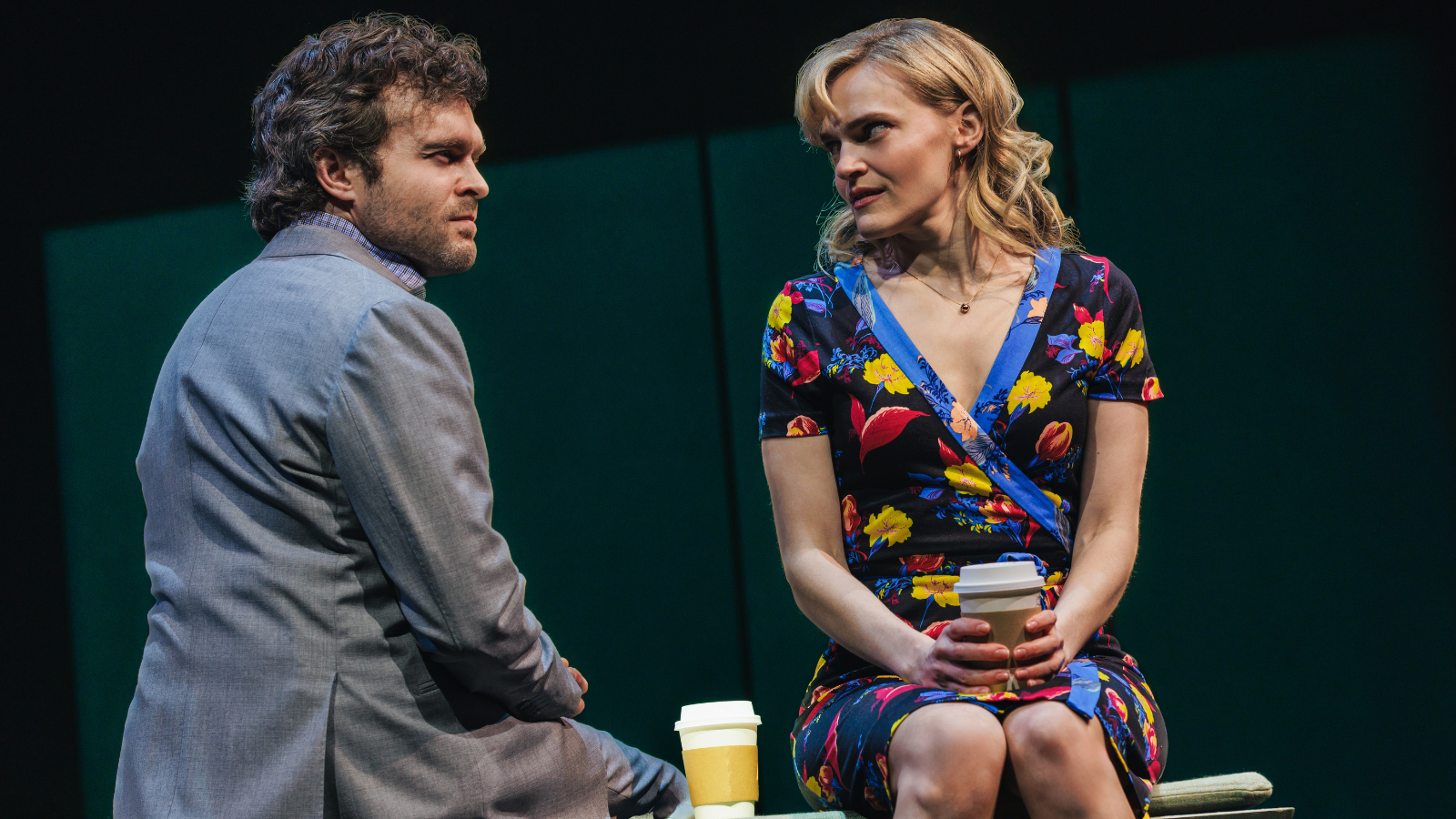
There’s a great, big soapbox waiting for me to step onto it and expound on why I think Becky Shaw, Gina Gionfriddo’s black comedy from 2008, is not appreciated, let alone remembered, despite it being a Pulitzer finalist. It has to do with misogyny and how we consider stories that deal with relationships or take place in the domestic sphere. But I fear the play’s characters might roll their eyes, if not outright hand me a noose, if I took to that box. Plus, assuming you’d never heard of it either, where’s the fun in spoiling an underdog’s greatest tricks?
Second Stage, which produced its off-Broadway premiere, has brought it back for a Broadway premiere that’s damn near perfect. Directed by Trip Cullman with a dynamism that perfectly matches Gionfriddo’s ever-surprising sensibilities, it introduces four pitch-perfect performances before its titular character even appears. Until then, it reacquaints us with mean comedy, the type that punches every which way without stooping to aimless, Scrappy-Doo belligerence. (Well, almost. Some stray jokes clearly cut for edginess might have been updated, along with references to The Love Boat and Jerry Lewis’ MDA telethons. But no matter.)
Its generosity of casual hostility is most sharply embodied in Max (Alden Ehrenreich, making a stellar Broadway debut). The play opens on Suzanna (Lauren Patten), a spoiled thirty-something wallowing in the loss of her father, who’s left behind a failing business with which her adopted brother Max, a financial manager, must contend. The two have the easy but latently tense relationship of longtime friends for whom sex has never technically been off the table.
Let’s not spoil the proceedings, though Gionfriddo’s characters constantly resist predictability. But Suzanna hastily marries Andrew (Patrick Ball), a softboy Brown graduate who attempts to coach his brother-in-law into saying things like, “Wow, that’s kind of outside my experience, so I would need for you to say more,” on their upcoming double date with Becky (Madeline Brewer), a new temp at his office.
The brilliance of Becky Shaw is in its laying bare of the softness deep within hard-asses and the nastiness of overly sweet people. No one is as they seem, until they are, until they’re not again, and Gionfriddo remains one step ahead. Though introduced as a frail little thing, Becky comes into the foursome with no baggage, and is thus the most consistently thrilling to track. Brewer imbues her with a quicksilver mix of doe-eyed horniness and hardened vulnerability. (Detailing her romantic past, she also epitomizes a remarkably sharp insight into white fragility.)
And then there’s matriarch Susan (Linda Emond), who wields the sharpest of the play’s cutting one-liners and finds a sort of kindred spirit in the impatient Max. Emond brings, not only assuredness, but a lived-in wisdom to her wit, and somehow subtly makes a meal out of each of her precious moments.
In a tight, all-around excellent ensemble, it’s Ehrenreich who emerges as the biggest surprise, and who hopefully becomes a theatre mainstay. This is an unmistakable asshole, the kind we rightfully seldom put up with anymore – but, damn, are they sexy when they want to be. He expertly crafts a jerk who is simultaneously covetable, pitiful and entirely human. This is, after all, a man who played Han Solo in a tragically underrated Star Wars entry (a franchise that continues to disown its best offerings) and has never been less than compulsively watchable in each role.
His Max is also a perfect key into understanding Suzanna, a tricky, almost thankless role which Patten handles in stride. The unspoken butt of much of the play’s jokes, Suzanna is a womanchild incapable of making decisions, and among a cast of explosive personalities, it could be easy to dismiss Patten’s performance as almost recessive. In keeping with the play’s ethos, though, she lands – and earns – its two biggest laughs.
David Zinn’s set takes a similar gamble: a characterless, barely appointed wall that diagonally bisects the stage, oppressively painted over in black. It accurately reflects the leads’ upper-middle-class Millennial milieu – Patrick Bateman’s even less defined younger siblings – shifting slightly through a handful of their hotel rooms and apartments, but it’s not particularly interesting to look at. A late reveal lays bare the experiential wealth of age.
Becky Shaw is a work of surprises. In a season of remarkably strong plays, many of which lead one, often expertly, to predetermined conclusions, this is one that presents itself with zero pretensions. In that relaxed calm, further smoothed by its laugh-a-minute comic instincts, questions may arise: What kind of partner am I? Who do I attract? Who do my friends attract? How do they treat their partners? Do I want that? Was that inherited? Gionfriddo offers no easy answers, despite how smoothly her invisible hand makes it all go down. Like your favorite frenemy, it begs for continued, spiky examination.
Becky Shaw is in performance at the Hayes Theatre on West 44th Street in New York City. For tickets and more information, visit here.


