


CATS: THE JELLICLE BALL Pushes Us Towards A More Fabulous Future — Review
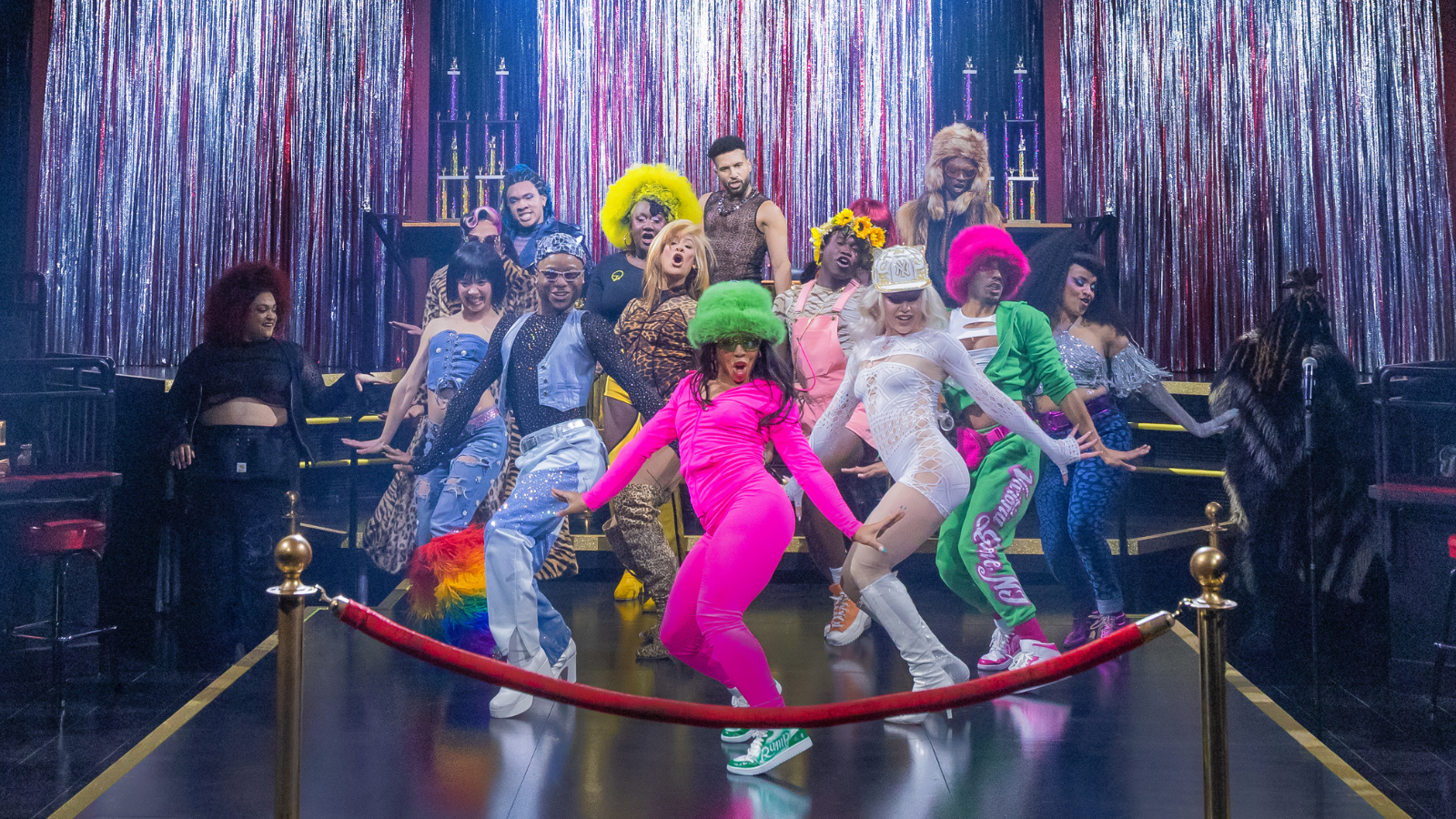
The Cast of Cats: The Jellicle Ball | Photo: Matthew Murphy and Evan Zimmerman for MurphyMade
Some fools will look to identify a singular moment in this transcendent Broadway transfer of Cats: The Jellicle Ball—a scene, a song, even a lighting shift—that lands with anything other than graceful perfection.
They may try. They won’t succeed.
“What about ‘Bustopher Jones’?” I hear you asking, foolishly. “That’s one of the weaker numbers in Cats, right?” Wrong. In this Ball, the vivacious Nora Schell has reinvented the “cat about town” as an incorrigible friend to all, a spirited lover of sex, drink and revelry. Bustopher is an icon now—get with it.
“Well, ‘Gus the Theatre Cat’ is always a bit dull, isn’t it?” you might suggest, recklessly. Idiot. Gus has been redefined as a ballroom veteran, still throwing shade from the box seats with the best of them; a wearily witty Junior LaBeija (of Paris Is Burning) owns the stage in the role, provoking waves of laughter with the slightest eye-roll.
“Are you really saying that even ‘The Ad-Dressing of Cats’ somehow lands?” Of course, you imbecile. The final number of Andrew Lloyd Webber’s enduring 1980s musical, which bizarrely chose to conclude with a treatise on proper engagement with felines, has been reframed as a counseling of respect for the ballroom legacy. Now you know—and don’t you forget.
The concept of Cats: The Jellicle Ball, now on Broadway at the Broadhurst Theatre following a celebrated run at PAC NYC in 2024, is as simple as it is demented: co-directors Zhailon Levingston and Bill Rauch have transposed Cats into the underground ballroom scene. A parade of “Jellicles” strutting their stuff here become battling performers in a ballroom competition. Old Deuteronomy (André De Shields) becomes a queer elder judging the competition. The narrator, Munkustrap (Dudney Joseph Jr.), is our catty Master of Ceremonies. And Grizabella (“Tempress” Chasity Moore) is a faded trans ballroom icon of yesteryear, cast aside by the world yet worshipped (if at a distance) by this new generation of “Cats” as a living legend.
It works. It works because the ballroom setting lends weight and specificity to a narrative world that previously felt airless, abstract to the point of nothingness. It works because Webber’s songs translate easily to ballroom categories. Most of all, it works because it’s a hell of a lot of fun.
And on Broadway, it somehow works even better. I did worry that something might get lost in the tighter confines of the Broadhurst—a flexible space at PAC had allowed for both a long runway on stage, and bustling actions on all sides. Could the magic survive the transfer?
I needn’t have fretted. On Broadway, Cats: The Jellicle Ball has both sharpened in its staging and deepened in its significance.
Scenic designer Rachel Hauck has masterfully reshaped the proscenium space, adding stage seating that blends seamlessly with the action. Choreographers Omari Wiles and Arturo Lyons utilize every nook and cranny of the Broadhurst, with Jellicles popping up on all sides. Wild movement work and meticulous lighting by Adam Honoré (the two elements working together far more smoothly than at PAC) keep our eyes focused on necessary action while still allowing space for the requisite ballroom frenzy—bodies everywhere, moving as one yet all, uniquely and thrillingly, telling their own individual story.
Dropped into a historic Broadway house, Jellicle Ball also plays more clearly and movingly as a defiant revolt of queer joy against a regressive and unadventurous culture still fighting its way out of the Stone Age. The voguers have, somehow, invaded a house of the establishment. And they’re wreaking gorgeous havoc.
Within that rich context, I found the high points of this production all the more intensely euphoric. The opener, “Jellicle Songs for Jellicle Cats,” is simply electrifying; “The Jellicle Ball” offers an overwhelming explosion of brightness and beauty; and the arrival of Old Deuteronomy, played by the incomparable De Shields, is sheer communal bliss. No other performer could command such a roaring audience response. That Shields is notably just a little frailer of body (though not mind or voice) adds only greater weight to his presence.
Other highlights include Sydney James Harcourt’s scorching hot take on “Bustopher Jones,” and a visit from “Skimbleshanks: The Railway Cat,” hilariously transfigured by Emma Sofia into the most fabulous MTA conductor you’ll ever meet.
Far from using the culture as a gimmick, Levingston and Rauch pay loving tribute to ballroom’s rich history. A tasteful history lesson at the top of the second act, paired with “Moments of Happiness,” provides an introduction for under-educated audience members like myself.
Under William Waldrop’s musical direction and supervision, a perfectly modulated band blasts Webber’s score (re-orchestrated to perfection by Webber and David Wilson, with some skillful help from beats arranger Trevor Holder) while never overwhelming the performers. And the already perfectly ostentatious costumes by Qween Jean have gotten a welcome upgrade for Broadway—over 500 looks, each as breathtaking as the last.
Lastly, of course there is Grizabella, the original “Glamour cat.” The sheer presence that Chasity Moore brings to this role elevates Jellicle Ball to devastating emotional heights. Moore’s rendition of “Memory” is ragged, and weary. It carries a weighty history, and years of pain. It is precisely all that history, deeply felt in this momentous staging, that makes both Moore and this production so otherworldly. This Ball is not just a remembrance of things past—it points a way forward, to a more fabulous future.


