


David Lindsay-Abaire Is Back On Broadway With THE BALUSTERS — Review
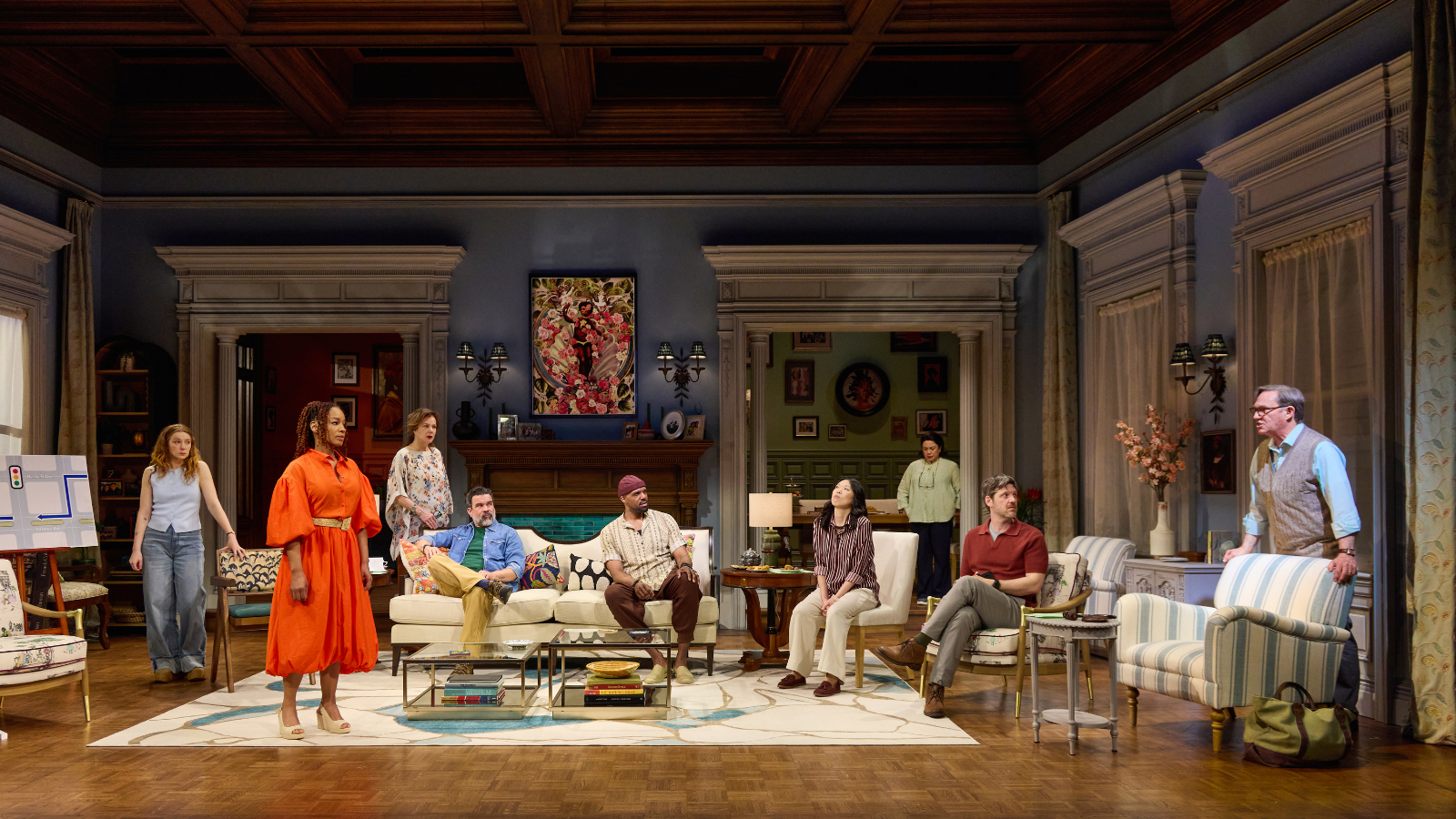
They say woke is dead. David Lindsay-Abaire has other ideas.
Lindsay-Abaire’s new play The Balusters makes a highly entertaining if specious argument for the eventual triumph—bad-faith cultural backlash be damned—of social justice in left-leaning America. Solidly staged by director Kenny Leon, this world premiere from Manhattan Theatre Club is witty and always engaging, though its ham-fistedness might leave you longing for the nuance of Lindsay-Abaire’s past triumphs.
Lindsay-Abaire’s masterwork is surely the 2011 play Good People, a devastating dissection of class division in South Boston memorably led on Broadway by Frances McDormard (also at the Samuel J. Friedman Theatre, where Balusters now makes its home). A Pulitzer winner for his finely-built weepy Rabbit Hole, Lindsay-Abaire knows how to deliver a satisfying living-room smackdown. But he also has a wacky streak, evidenced by the playwright’s darkly comic 2001 work Kimberly Akimbo (and its 2021 musical adaptation, for which Lindsay-Abaire wrote the book), along with the slapstick silliness of his 2015 play Ripcord.
The Balusters is a collision of these two aesthetics, as though Lindsay-Abaire’s proficiency for well-made plays is battling it out, moment for moment, against that penchant for wacked-out fun. The result is a welcome blend of highbrow and low. And that tonal mismash proves fitting for Lindsay-Abaire’s setting, a Neighborhood Association Group in the (fictional) suburban enclave of Vernon Point—a place where very privileged people are very serious about very trivial matters. In Vernon Point, the notion of a neighbor installing, gasp, "Aluminium siding on a Victorian!” is enough to throw certain residents into hysterics.
The preservationist-versus-progress fracas at the play’s center is set off by a new arrival, Kyra (Anika Noni Rose), who suggests installing a stop sign on a corner near her home. Kyra is alarmed, quite reasonably, by speeding drivers hurtling through the intersection. But longtime President of the Neighborhood Association, Elliott (Richard Thomas), is far more dismayed by the prospect of spoiling a perfectly preserved esplanade. Looking down their street, he explains to Kyra, is “like standing in an old postcard.”
We’re not exactly in the land of delicate nuance here. When Elliott starts raging (albeit with a plastered, polite smile on his face) against a neighbor’s installation of period-inaccurate balusters on their porch, he declares: “The balusters are important—they hold everything up.” Subtle stuff.
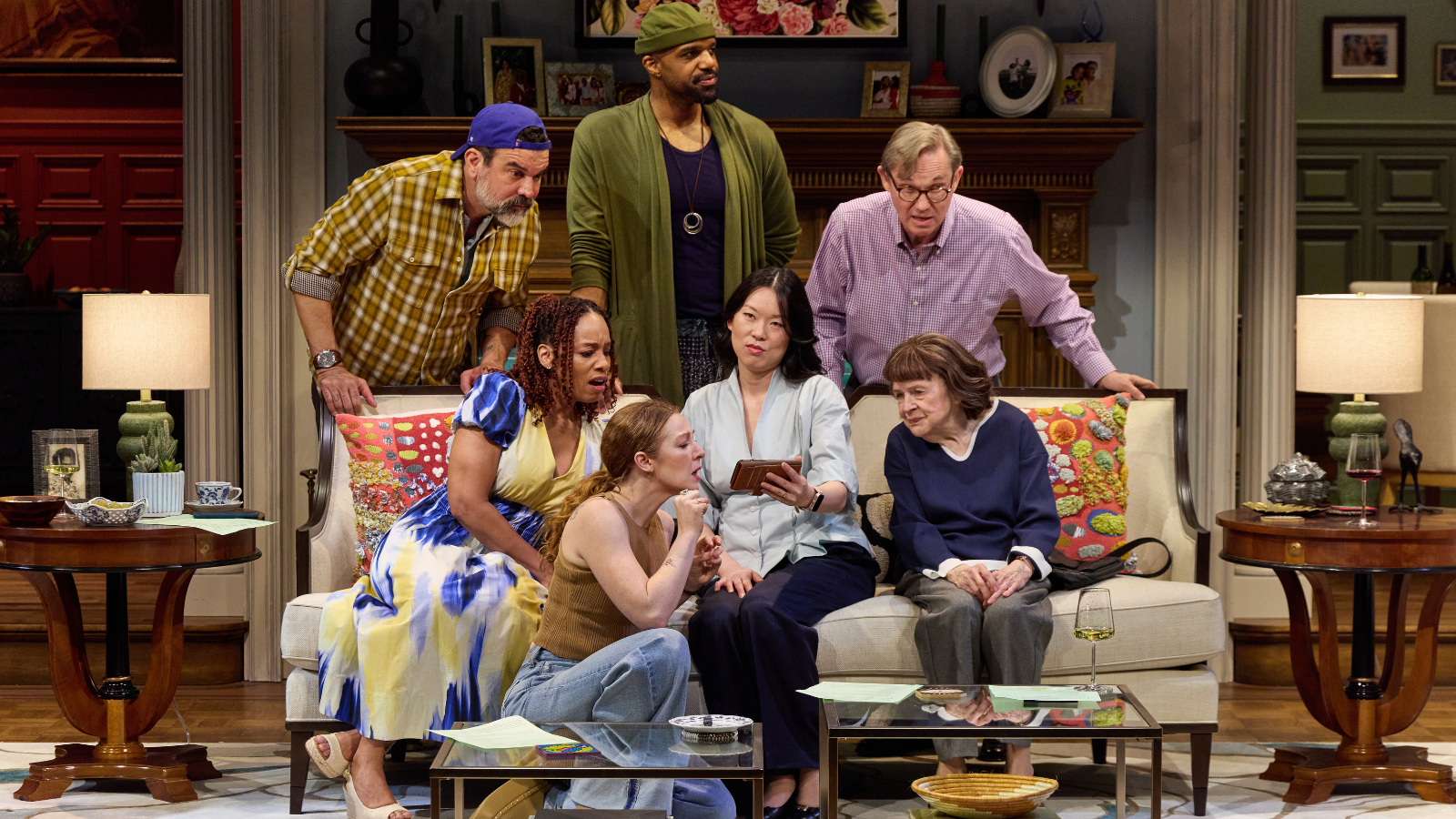
Kyra’s proposal sets off a well-mannered battle between herself and Elliott that escalates, gradually, into full-on emotional warfare. Other members of the Association are forced (or in some cases, are all too happy) to pick a side. An over-qualified ensemble of season theater veterans are here enjoying themselves immensely, with standouts including the razor-sharp Jenna Yi, a dryly hilarious Carl Clemons-Hopkins and a carefully controlled Maria-Christina Oliveras.
I was especially thrilled by the always excellent Michael Esper as mild-mannered Alan, who grows increasingly frazzled every time his security updates are interrupted. Alan finally snaps when he is accused by Willow, the group’s resident “PC scold” (played meekly by an underserved Kayli Carter), of the worst crime imaginable: hurtful microaggressions.
In terms of humor, Lindsay-Abaire pitches the tonal balance near perfectly. Everyone gets their turn as the target of sharp barbs: the over-sensitive Willow, driven to tears by an accusation of performative allyship; the imperious Ruth (Margaret Colin), whose constant insults are exposed as weakly defenses; and even Kyra herself, whose outward pretence of good manners is carefully punctured. In truth, Kyra likes a bit of drama, like all of them (and just like us). And it’s great fun when the play devolves into a diva-off between Rose and Thomas, who is in his element.
Yet reflecting on the play after viewing, the takeaway starts to feel muddy. Sure, Lindsay-Abaire has his equal opportunity fun mocking all these various open-minded denizens of this closed-off community. But ultimately, Elliott is cleanly presented as our villain, a brick wall of dogmatic resistance to even the most gradual change. Elliott becomes an easy avatar for all the old, white leaders who refuse to step aside and make space for fresh leadership. He must be brought down, and when he is, we shall all triumphantly applaud.
None of that is wrong, but it is maybe a little easy. More fatally, Lindsay-Abaire has never really given us a fully-rounded sense of Kyra, a character who feels half-formed despite the best efforts of Rose (first-rate as always). There are glimpses here and there, especially in Rose’s flashes of righteous anger, of a more complex characterization. But by the end, she feels more like a representation of generalized “change.” Meanwhile the villainous Elliott, for all his awfulness, always feels like a real person. His obstinance is placed in a fuller cultural context than any understanding Lindsay-Abaire can access in writing Kyra.
The Balusters concludes with a victory for social justice and the raising up of marginalized voices in a manner that feels tidy. It’s satisfying, yes—and perhaps Lindsay-Abaire is allowing himself a bit of fantasy by pushing that still-raging right-wing backlash out of his narrative frame. But great satire surely has to confront the ugliness, not pretend it away. The culture wars are still raging, and there is no victory in sight—nice as that might be to imagine.
The Balusters is now in performance at the Samuel J. Friedman Theatre on West 47th Street in New York City. For tickets and more information, visit here.


