



GIANT: John Lithgow’s Uneasy Dahl – Review

Mark Rosenblatt’s play Giant is brilliantly structured, quite funny and, in Nicholas Hytner’s production, superbly acted by a cast led by John Lithgow. I wish it didn’t irk me the way it did.
Lithgow plays Roald Dahl in 1983, when the pending release of his book The Witches is shrouded by the controversy he’d stirred through an article in which he condemned Israel’s recent invasion of Lebanon and shamed Jews for not denouncing the act. Whether that last item was a crass overstep or a sign of latent antisemitism is the subject of the play, as a Jewish woman from his American publishing house is sent to his home in England to persuade him to apologize. He refuses, unwilling to bow to public opinion, and the clever nastiness which made his stories so indelible reveals itself to be one of his key character traits, as he needles her with increasingly insensitive remarks whose intentions are fiendishly evasive: does he mean what he says, is he simply enamored by the process of devising new jabs, or is it all just for attention?
How personalities are conveyed, revelations meted, and momentum sustained is a testament to Rosenblatt’s immense talent. The Dahl he and Lithgow create is a towering dramatic figure and a completely rounded character. He is also the piece’s obvious villain from the very beginning. Despite the complications it purports to admit to this foregone conclusion (his charity work, the bond he develops with Jessie, the American, over their children), the play’s tension comes from waiting for Dahl to crack and finally confirm our suspicions. But while Dahl increases in complexity, Jessie is smoothed out into a righteous heroine with an act-ending dressing down of her opponent. Sides are thus taken, and every word spoken takes on the tenor of that bigger discussion.
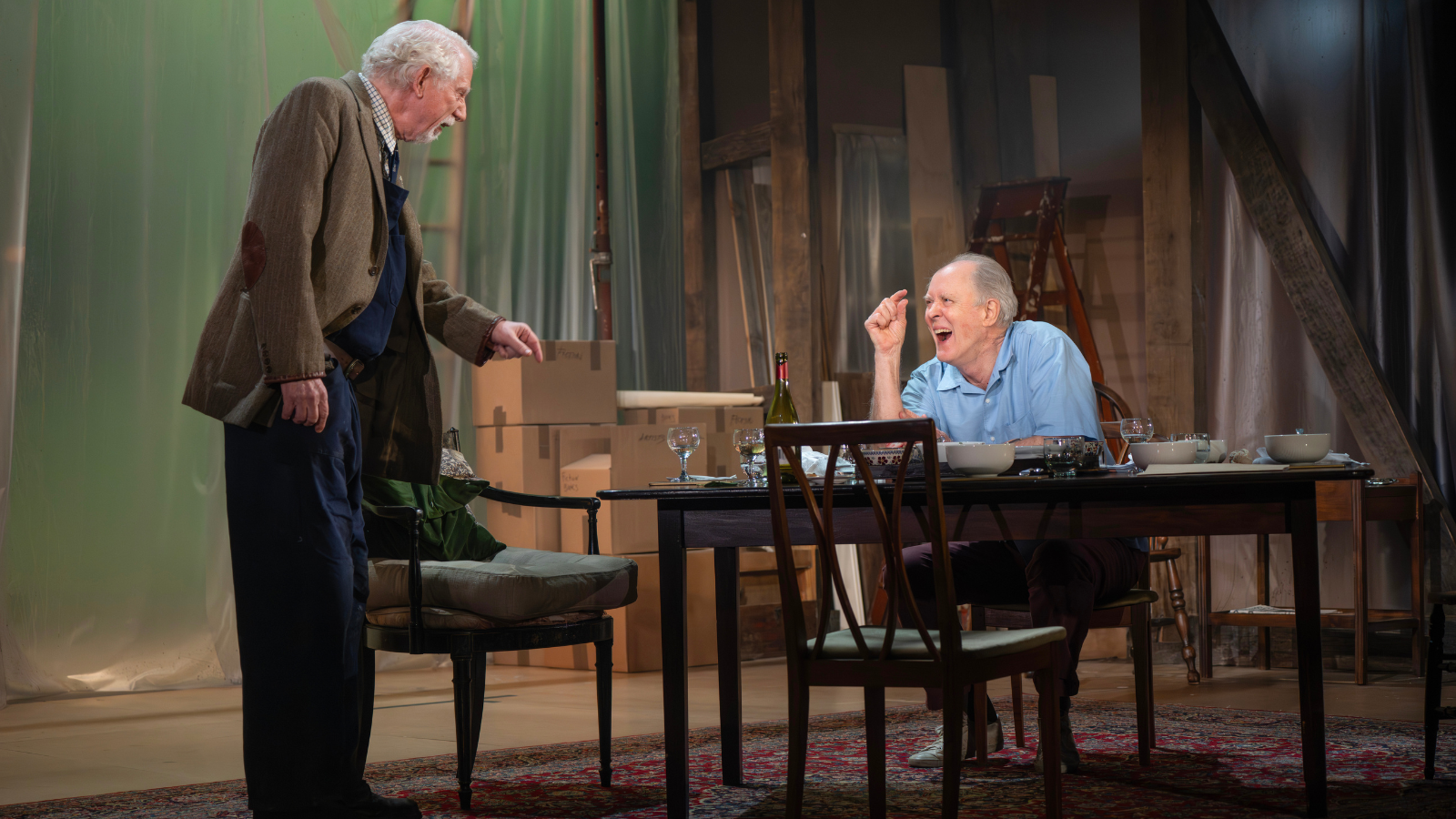
Still, Giant spends some two hours playing is-he-or-isn’t-he before a mic drop finale that conclusively proves (by dramatizing an actual interview he gave to The New Statesman) that he is. Or, in the most undeservedly graceful reading, that his stubbornness so blinds him to consequence that he’d be willing to sound like he is. It’s a terrific character study. The issue is that Giant also spends those two hours playing cat and mouse with the broader question of whether anti-zionism equals antisemitism; Dahl being the only character to firmly decry the invasion and take issue with Israel’s governance. He dodges the main accusation by bringing up valid concerns over war, displacement and colonialism, which erroneously and irresponsibly intertwines the two thoughts as the play goes on. Closing the play on a confirmation of Dahl’s antisemitism, Rosenblatt bangs the gavel on the conflation: if Dahl was lying about the roots of his anti-zionism, surely so must others be guilty of that masquerade. For all its dramatic pleasures and gestures towards nuance, Giant winds up feeling like the latest example of a type of weaponized censorship that deems any criticism of governments as human-scale hate speech.
Giant is in performance through June 28, 2026 at the Music Box Theatre on West 45th Street in New York City. For tickets and more information, visit here.


