


Hugo Williams Wants BURNOUT PARADISE To Run — But with its Edge Intact
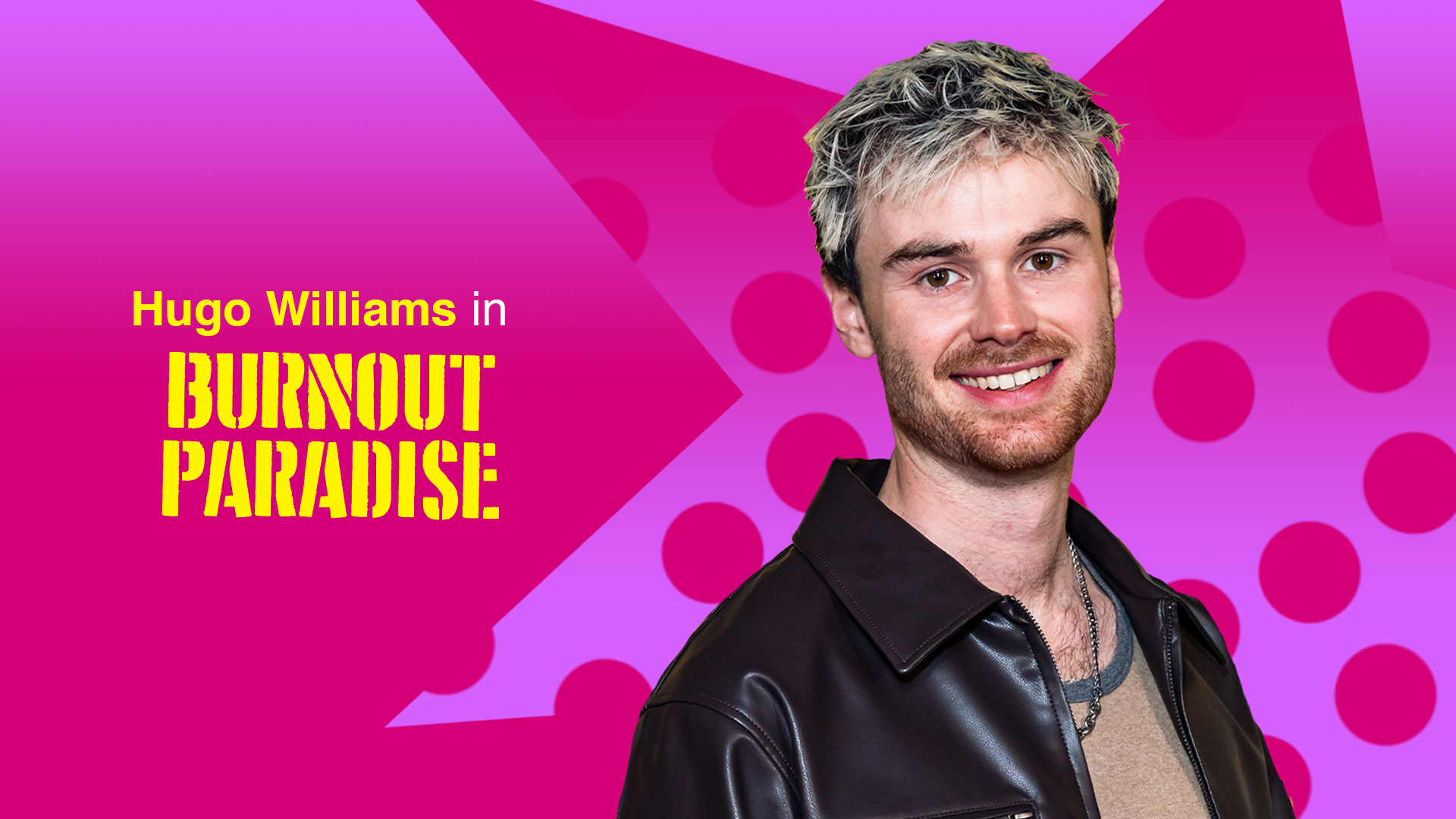
Midway through a recent performance of Burnout Paradise, the manic theatrical experiment now running off-Broadway at the Astor Place Theater, an audience member e-mailed Hugo Williams an 80-word treatise on community.
As Williams scanned the essay, he had some critiques.
Of course, this wasn’t an ideal moment to deliver feedback. Williams was looking at a computer while onstage running on a treadmill, attempting to complete a multi-part grant application while a 10-minute timer above him counted down. He needed to keep pace with a previous distance record. And he was working collaboratively with his fellow performers onstage, three of them also sprinting on treadmills while completing complex tasks of their own.
Was now the best time to challenge the premise of this text before him? An enthusiastic spectator, asked to explain the importance of the show they were watching, had suggested that community-building pieces like Burnout were an essential bulwark against the ever-encroaching threat of fascism.
“I said, “Fuck it, I’m going to engage with this,” said Williams. After finding the essay’s author in the crowd, he yelled out: “‘Isn’t fascism community? Isn’t that one of fascism’s greatest strengths, its ability to create connection between people in spite of others?’”
As Williams recalled to Theatrely on a recent Zoom, the essay’s author did not retreat or recoil. Roping in a second volunteer, the audience member instead re-drafted and expanded their thoughts, fine-tuning a paean to community care within oppressive societal systems.
Williams smiles at the memory. “Those are the moments I’m looking for.”
If re-drafting essays about fascism doesn’t entice you, never fear. You won’t be required to write, or indeed to do anything, if you attend Burnout Paradise. But you’ll still feel involved. Every spectator shapes the energy of this madcap interactive piece, first created by Australian company Pony Cam Collective in 2023.
Over a 65-minute running time, four tireless performers fulfill a series of escalating tasks while continuously running on treadmills. These duties vary from the aforementioned grant application (dubbed the “Admin” track), to performing a soliloquy (“Performance”), to cooking a three-course meal (“Survival”) to a miscellaneous assortment of mini-chores (“Lesiure”). Four performers swap among the treadmills throughout the show, trading off tasks; a fifth oversees the action, tabulating the scores and handing out Gatorade. (If you’d like one, just yell “Gatorade,” and they’ll come running.) From moment one, the audience is enlisted to run up onstage and help out. And while participation is voluntary, it is impossible for the performers to successfully hit their goals without our assistance.
Oh—and if the performers do not fulfill every task before them and meet or exceed their existing run time goal, everyone is entitled to a full refund.
Burnout traveled improbably from its premiere at Melbourne Fringe Festival in 2023 to a worldwide tour, including a stop at St. Ann’s Warehouse in Brooklyn in 2024. It now returns to New York in the same theater where Blue Man Group, another unlikely commercial project with D.I.Y. roots (in that case, the late ‘80s East Village arts scene), ran for three decades and over 17,000 performances. Could Burnout follow in Blue Man’s footsteps?
Williams doesn’t presume to even speak aloud the notion, but he’s keenly aware of the Blue Man legacy at Astor Place and in the local area. (Multiple staff in the building worked on the show, and two Blue Man co-creators still live above the theater.)
“I know what a show like that can do for a scene, for a community, and for the artists that are a part of it,” said Williams. “A show that creates risk and invitation, and has some sort of gimmick that is fun for word of mouth. Not just us, but the artists that get to be on the treadmills after us, if we’re ever so lucky to get into a place like that.”
As the show settles into this new commercial context, Williams, who created and performs Burnout alongside his Pony Cam family— Claire Bird, Ava Campbell, William Strom and Dominic Weintraub—is intent on keeping hold of the piece’s experimental roots, and its essential ideas around community care, exploitative systems and the roots of our collective burnout.
“Playfulness without substance can just evaporate underneath you,” said Williams. Even six weeks into the Astor Place run, he already sees it happening: “Some shows, I feel like the spectacle of the thing has taken over.”
To combat this, Williams pushes volunteers to focus intensely on the task before them. If an audience member jumping onstage views their assignment as a lark, Williams will kindly but firmly shut that down.
“I will try to go: ‘Look at me—there is no reason that we need to try hard right now—but if you look at me in the eyes, and you really embrace whatever feeling is in your body, that’s the stakes,” said Williams. “Know that there are stakes. There aren’t, but there are.’”
The playfulness remains present, but only alongside a seriousness of intent. And rarely, in Williams’ experience, does anyone refuse to lock in.
“Everyone is like, “I hear you, I’m with you,”” he smiles. “And that’s a really beautiful thing. That commitment to each other around imaginary stakes is really just the heart of performance.”
The pressure is so much more than when Burnout was a six-person team, with everyone doing a bit of everything. Now, the staff in the building includes two understudies, a stage manager, a company manager, two crew members, front of house and box office.
“What is the responsibility to them?” wonders Williams. The Burnout team is not immune from the same capitalist cycles their show is attempting to interrogate.
A strictly bottom-line mentality would keep Williams focused on completing tasks as quickly as possible, and beating his running time. That would mean no refunds offered, which hopefully keeps the show running longer. (Yes, people really do take up that refund option.)
“And the show’s selling all right, it’s selling pretty well, but it needs to sell better than it currently is,” said Williams. “And that pressure is looming over me every show.”
But he keeps taking the time. He did so, again, for a young kid at a recent performance. Initially, Williams admits, he greeted the boy’s arrival on stage with: “I have no time for you.”
“And this kid was like, “‘But I really want to help.’”
Equipping him with a basketball hoop, Williams sent the boy up to the balcony. Williams tossed a basketball at him, missed. “I yelled, ‘Mate, you gotta help me out!! You’re not holding the hoop, you are the hoop!’”
They tried again. Williams took a throw; the kid followed the ball, lunging himself forward, and caught it in the hoop.
“And the pleasure on his face…it was so immense,” said Williams, grinning at the memory.
“He really cared, and he committed to something. And he got a good reward.”


