


Paola Lázaro Talks How Her Friendship Inspired Her Character in DOG DAY AFTERNOON
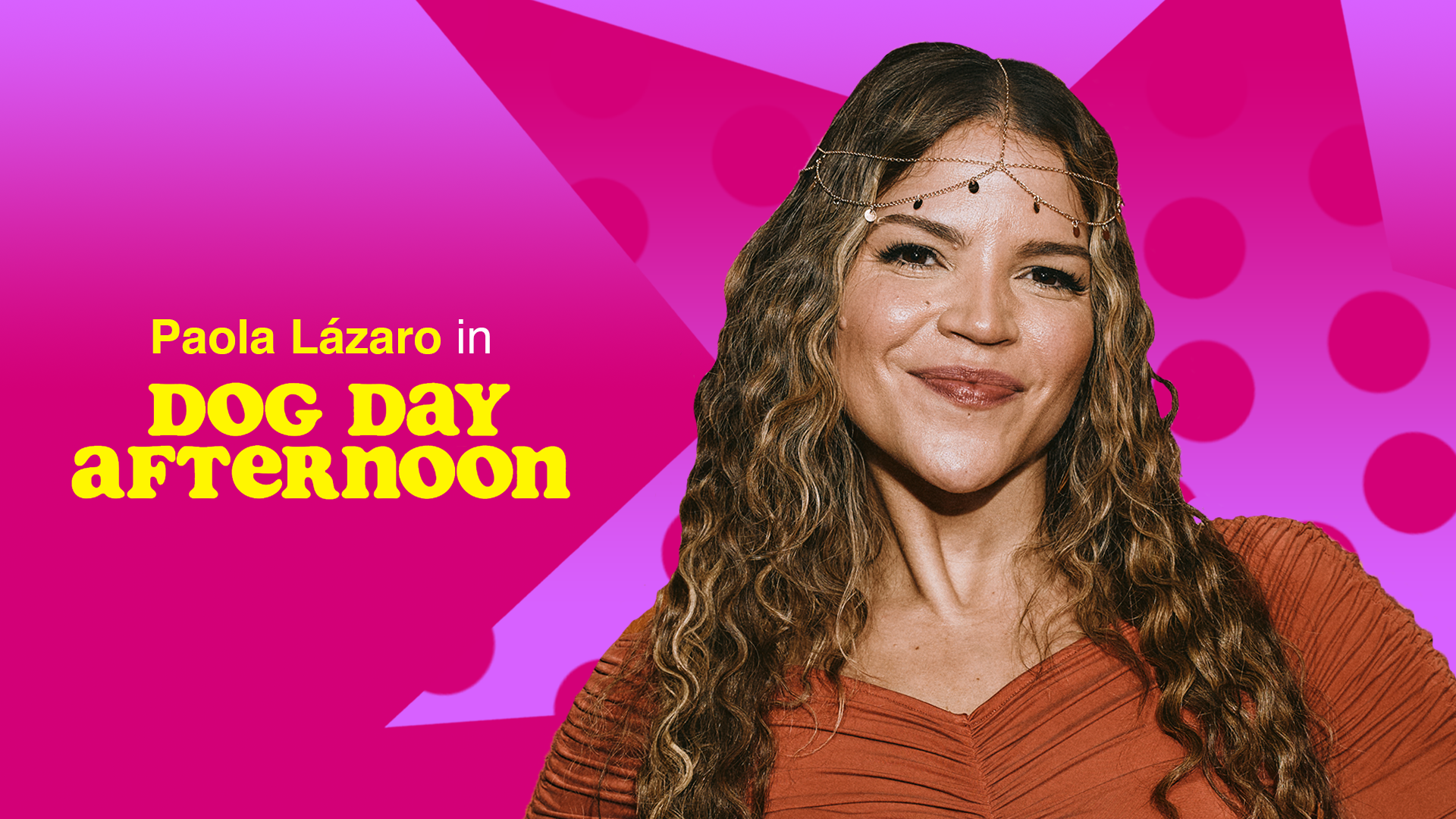
Paola Lázaro and Dog Day Afternoon go way back. The celebrated actress and playwright, best known as Juanita “Princess” Sanchez from hit series The Walking Dead, has spent eight years involved with the development process for this screen-to-stage adaptation.
But Lázaro’s history with Dog Day goes back even further than that. She was first introduced to Sidney Lumet’s 1975 classic by playwright Stephen Adly Guirgis, long before he was involved in writing a stage version. Now, Lázaro is making her Broadway debut in a Guirgis-penned stage version of Dog Day as Guadalupe, a hippie who finds an unlikely connection with Ebon Moss-Bachrach’s Sal.
Theatrely sat down with Lázaro to discuss the character of Guadalupe, created specifically with her in mind by Guirgis; working with Jon Bernthal; and her pivotal song in the show.
Tell us about your character in Dog Day Afternoon, Guadalupe. She enters the play in a very funny way.
She comes in from the bathroom. [laughs] I’m not gonna say why. She’s a hippie type, and really apart from the world of the bank. She works there, sort of. But mostly, she can’t get fired because her uncle drives a limo for one of the bank officers in Manhattan.
You are a playwright yourself, and a longtime friend of Stephen Adly Guirgis. Did you contribute at all as he was crafting Guadalupe?
Her cursing out people in Spanish is definitely based on our friendship, and how I was when he first met me. The specific Puerto Rican Spanish we crafted and played around with together. I also mentioned The Young Lords. They were an activist pro-independence group in Puerto Rico. So I said, maybe this character hangs out with the Young Lords—maybe she’s not just a hippie, but also an activist.
Over the course of the play, all the other bank employees get close with Sonny, played by Jon Bernthal. But Guadalupe is the only one who takes an interest in Ebon Moss-Bachrach’s Sal, who on the surface seems a lot scarier.
Stephen said to me: “Sal is a dog. You grew up with dogs. You know how to deal with them.” In my own life as well, I know how to deal with bombs that are about to explode. I grew up diffusing those [people]. I think that she’s interested in Sal. Not in a romantic way, but more like: “I know you.” People who have that anger, they just want to be seen, ya know? If you talk to them, in a way where you’re not judging them, then maybe you get through to them.
Late in the show, you take out your guitar and play a song for Sal. It comes right before the finale, when it’s not clear what’s going to happen. It felt like a mournful moment to me. How do you approach that song?
The song is called “Sabor A Mi.” It is a standard bolero song, a bolero classic, and it’s about love. It’s about having someone’s taste in you, the taste of their life, and always keeping that in you. The way I approached that moment is, I want to give Sal a little bit of joy, and maybe make him laugh. That’s why we play around with the song, and why Guadalupe gets lost a couple times. We didn’t want her to seem like some maestro. She’s just this stoned, hippie chick that is trying to figure out this song. It provides some levity, in the calm before the storm.
It’s kind of a moment for the characters, and also us as the audience, to pause and take a breath. Before we head into the finale.
I think there’s an understanding that this could go horribly wrong—for any of us. So yes, it’s a moment of reflection. A moment to think about all the events of the day, and how we’ve all been changed by it. This disparate group of people who have connected in a way that would never have happened otherwise.
In the film version of Dog Day Afternoon, the equivalent of your character is a bank teller named Maria. But it’s a very different character, and a smaller role. How did Guadalupe come into existence?
A lot of the time, Stephen writes for his people. I’m a LAByrinth Theater Company member, and Stephen was my mentor in Columbia’s graduate playwriting program.
So how early did he say he was picturing you?
From the get-go, from the first readings we did. We’ve been developing it with Warner Brothers for about eight years, and a lot of us have been involved since the beginning: Esteban Andres Cruz, who plays Leon; Andrew Syglowski, who plays Alison; Wilelmina Olivia-Garcia, who plays Lorna; Elizabeth Canavan, who plays multiple roles. And then Jon Bernthal joined us in the process about three years ago.
You have that Walking Dead connection with Jon, though you guys didn’t overlap on the show.
Walking Dead has such a supportive fanbase. I’ve met with some of the fans after the show. It’s exciting for them to see us playing together in the same space. And Jon is a great leader. I mean, there’s not enough good things I could say about that guy. He cares so deeply about this show and this character, and I think it shows when he’s up there riling up the crowd. That’s not an easy thing to do.
Given that Stephen has been this mentor figure to you over the years, what has it felt like to originate a role in one of his plays on Broadway?
It’s absolutely beautiful. LAByrinth and Stephen specifically really saved my life, in a way. They gave me community and family. Stephen saw something in me, a future in me. He was the one who introduced me to LAByrnith, and gave me that family. And it changed my life.
Stephen sees people, and has compassion for people, and I think that shows in his writing. It shows in my scenes with Sal—you get to see this different side of Sal, where he’s kind of like a little boy. A little boy who probably never had love in his life. Stephen is very good at that. I can’t imagine anyone but Stephen writing this play. I think it was meant to be.


