


An Incredibly Strong Ensemble With HERE THERE ARE BLUEBERRIES — Review
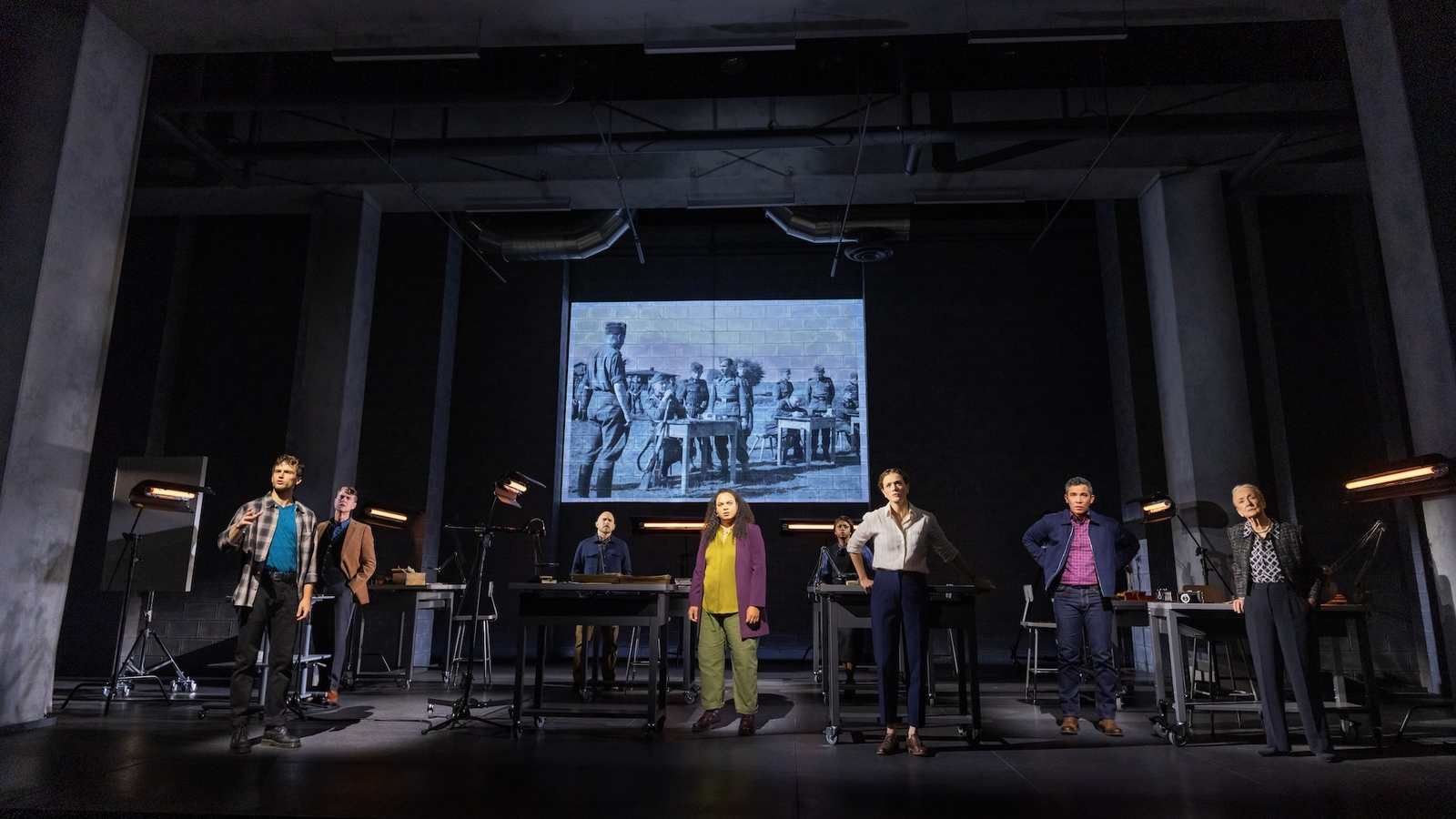
Here There Are Blueberries begins, not too convincingly, as a detective story. Tectonic Theater Project’s investigative piece, premiered at La Jolla Playhouse in 2022 and now playing a limited Broadway run at the Barrymore Theatre, lives unnaturally in that mode of storytelling for a time before opening out into more intriguing, dramatically coherent questions. Once it reaches those larger inquiries, Blueberries does prove a stirring piece of theater—if not always a natural fit for a Broadway stage.
To begin, a photo album has landed on the desk of historian Rebecca Erbelding (Elizabeth Shahlmann), an archivist at the National Holocaust Museum in Washington, D.C. The album depicts daily life in and around Auschwitz from the perspective of the camp’s military leaders, their families, and various staff. These photos are frightening in their normalcy: parties, days off lounging in beach chairs, children playing in front yards. Just outside the frame, a mass extermination event goes unacknowledged.
The album in question was first discovered in 2006, then made public by the museum two years later. It earned global headlines and renewed a push to track down and prosecute leading Nazi commanders depicted in the photos. Following years of interviews and extensive research into the album and its fallout, the acclaimed company Tectonic (best known for The Laramie Project) debuted Here There Are Blueberries in 2022 at La Jolla, followed by an off-Broadway production at New York Theatre Workshop in 2024. The text is by Tectonic artistic director Moisés Kaufman and author Amanda Gronich; Kaufman directs this Broadway staging, as on previous productions.
The play’s early scenes focus on Erbelding investigating the album’s content. Alongside a staff of researchers she pieces together the identities of those pictured, the locations of the shots and the time period covered in the photographs. The text by Kaufman and Gronich tends to frame each new discovery as a shocking revelation, many gravely intoned by either Erbelding herself or other staffers. Under Kaufman’s direction, the delivery feels stagy, lines thrown at us with vocal underling and italicization to highlight the significance.
The impulse to inject some narrative drama into this research process is understandable, but it all feels a bit forced. Much of what we’re learning feels routine to any historical research process, and it is hardly detective work. The owner of the album, SS Commander Karl Hocker, is identified straightforwardly by photo captions; a resort nearby Auschwitz named Solahütte is located by reviewing maps and nearby geography. It would be enough, I think, to here simply depict a set of smart and competent minds performing their jobs with skill. That can be thrilling all on its own.
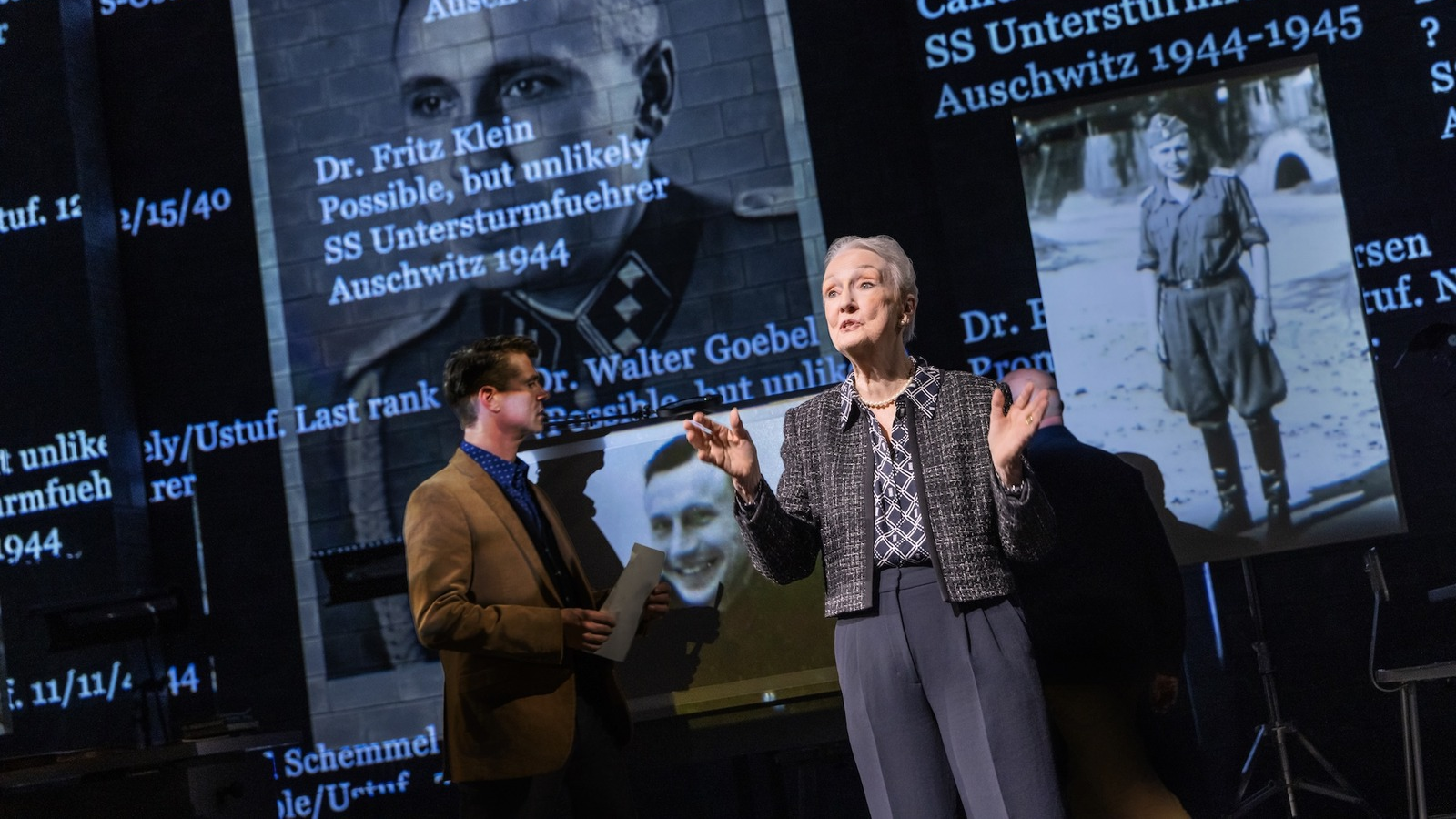
The same approach could have better served scenes where Erbelding and her various superiors (portrayed by Kathleen Chalfant, Montego Glover and Brandon Flynn) debate the ethical questions posed by releasing and exhibiting the photos. Would it risk humanizing the perpetrators of mass murder? Does it fit the mission of the museum? These are intriguing questions, and they do take on a fuller life later in the play. But again, the performers are pushed to play these debates as tense, even deeply personal. I was not totally convinced—would professional researchers talk to each other this way?
But there is more still to unfold in Kaufman’s elegantly austere staging, which begins as lecture-style but gradually finds some warmth. Scenes focused on unpacking the photos themselves play awkwardly on the larger Barrymore stage—even seated in the orchestra, I felt at a great distance from the images, which projection designer David Bengali mostly places on the upstage wall.
Yet this strong ensemble of performers do generate a feeling of direct connection with the audience, close at times to intimacy. The most successful in this regard is the esteemable Kathleen Chalfant, a performer of rare grace who always feels like she is speaking directly to you. Michelle Beck is similarly strong, while Scott Barrow does careful work in multiple historical roles while steering clear of direct impersonation. Tony Award winner Michael Ceveris is also excellent, most especially as a descendant of Nazi officers struggling with his family inheritance.
That question of inheritance is powerfully explored in a scene centering Rainer Höss, the son of Auschwitz commander Rudolph Höss and a man gripped by violent and destructive urges that he fears live inexorably in his blood. The scene includes a challenging monologue, probably the play’s most daring, that Flynn plays with careful restraint. (His scene partner Conrad Ricamora is unfortunately flat as Tilman Taube.)
Höss’s monologue leads us into the strongest and most resonant theme of Blueberries, one that pushes its audience to look inward: how different are any of us, truly, from the people depicted in this album? The normalcy of the photos drives the point home. Are we capable, under the right circumstances, of similar barbarity?
“We have to look for ourselves,” concludes Erbelding, “in every picture.”
She means not just the officers, but also their families, who knew everything; or the staffers, many of them young women, who knew everything. She means not just the direct perpetrators—though yes, that could be us—but also the accessories, the ones who carried on their lives while ignoring all that lived outside their personal frame.
In terms of contemporary resonance, the idea is left amorphous, a notion to be chewed on without specificity. I reflected personally, on the devastation in Gaza; I also thought of the daily violence inflicted by ICE across the United States. I thought of our smaller and daily capacities for cruelty, seen and inflicted by all of us in daily capitalist life, in ways both very big and minutely small. The expansiveness of the final question has frustrated some critics, and reasonably so. But for me, it feels right for this particular story, centered on this particular album. Evil is everywhere, and it does not have a special face. It is in you, and me, and all of us.
here There Are Blueberries is now in performance at the Barrymore Theatre on West 47th Street in New York City. For tickets and more information, visit here.


