


The Clarke Sisters Get Their Broadway Debut In WANTED — Review
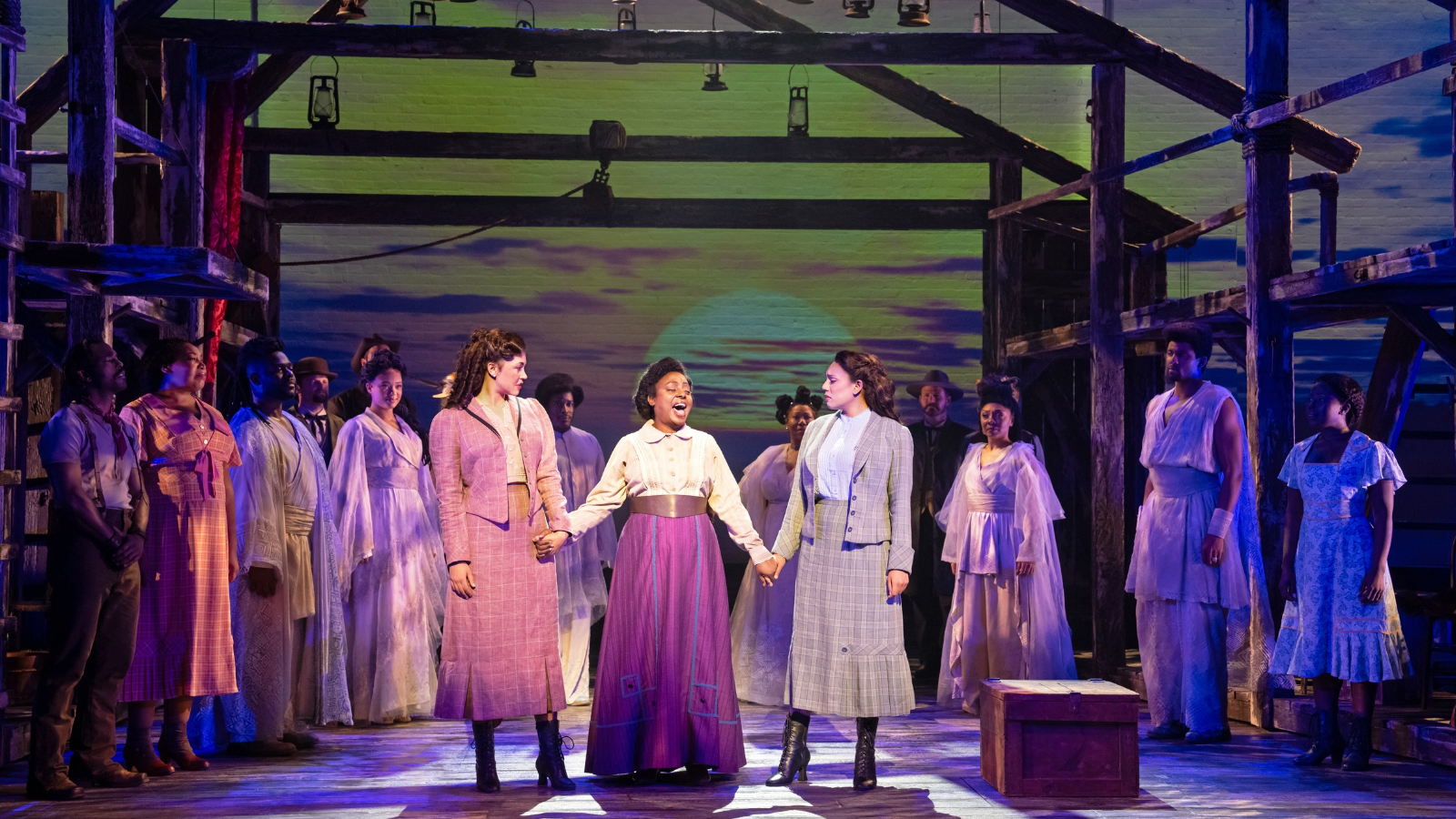
In dreaming up her new musical Wanted, which opens tonight on Broadway at the James Earl Jones Theatre, book writer and lyricist Angelica Chéri was inspired by an astonishing piece of family lore. The author’s great-great aunts Mary and Martha Clarke, two Black women who passed as white in the post-Reconstruction South, were said to have been outlaws: robbing trains, scamming white men and even killing a few (likely deserving) folks in the process.
As family legends go, no question that this one is a killer premise for a Spaghetti Western-style country musical anchored by two fiery female performers. And when Chéri and Wanted composer Ross Baum stick closely to that central concept, this ambitious original work is certainly a rollicking ride.
Sadly, the frequently disjointed final product too often feels like a victim of overdevelopment. Following a 12-year process of writing, rewriting and two out-of-town tryouts, Wanted now packs in multiple ambitious narrative goals: high-spirited western action, twin love stories, a mediation on racial assimilation and a reflection on the still-unfulfilled promise of reconstruction.
It is a lot for one musical to carry—all the more so when the authors, Chéri and Baum, are both making their Broadway debuts. In the production on stage at the Jones, one feels that strain, the struggle of an uncertain object pulled in several directions at once.
Wanted is most successful as a bitingly satirical piece, and that sense of humor best deployed in early scenes depicting the Clarke’s first outlawing efforts. The headstrong Martha (Lisi LaFontaine) and softer, more hesitant Mary (Solea Pfeiffer) almost stumble into gangster life, and both performers have great fun with these absurd early efforts. A sequence depicting the pair encountering white America for the first time and learning to imitate Southern white pleasantries is witty, surprising, and produces some of Chéri’s sharpest lyrics.
Those lyrics and Baum’s score are admirably multifaceted, shifting between country, blues, gospel and R&B. An ear worm of a former title number, “Gun & Powder” (a name that should have been retained), shakes the rafters early in the first act, thrillingly melding gospel vocals and country rock orchestrations (by John Clancy). And the ever-undersung Katie Thompson, back on Broadway where she belongs, demolishes a swinging solo that introduces us to the fine hotel where Mary and Martha ultimately land and both encounter key love interests.
One other genius injection of humor comes in the arrival of Sissy and Flo (Aurelia Williams and Awa Sal Secka, respectively), two Black servants at the hotel who clock Mary and Martha immediately. The pair’s commentary is hilariously on point, and this sharp duo steal every scene they appear in.
But after Wanted decides to stick around at the hotel owned by Jesse Whitewater (Bradley Jaden) and shift its focus to those two competing love stories, the show quickly runs out of steam. The realization that we’re basically done with outlaw-ing, only partway through the show’s first act, is not a welcome one. A story that desperately wants to move and keep on pressing forward is instead forcibly brought to a screeching halt.
The two men themselves are a drag, interesting as concepts but uncompelling as flesh and blood. The idea of Martha genuinely falling for white hotel owner Jesse whilst still fiercely guarding the secret of her race is an intriguing one; that she is also lured by the comforts of white life feels truthful. But Pfeiffer and Jaden find no natural chemistry, so that love is never palpable. As played by the very capable Jaden, Jesse himself is utterly devoid of charm—I fear that this performer, so excellent in this summer’s Les Misérables Arena Spectacular, was simply miscast here.
Luke James is similarly brooding as Elijah, albeit in a role where somber withdrawal makes sense. A subordinate of Jesse’s, he carries a heavy past, and opens up slowly to the steely Mary. But there is no heat between James and LaFontaine, and James’ two forgettable solos lend little texture to Elijah’s backstory. (That backstory winds up feeling, awkwardly, like a plot device more than anything else.)
Much of the narrative business of Mary and Martha’s story becomes plodding and incoherent in the show’s second act, most fatally in an unconvincing act one finale cliffhanger that proves to have no long-term significance. For much of act two, the basic geography of Mary’s location is unclear, her goals even less so; separating the two sisters for so long and feels like a fatal error, one that robs us needlessly of these two performers’ effortless chemistry.
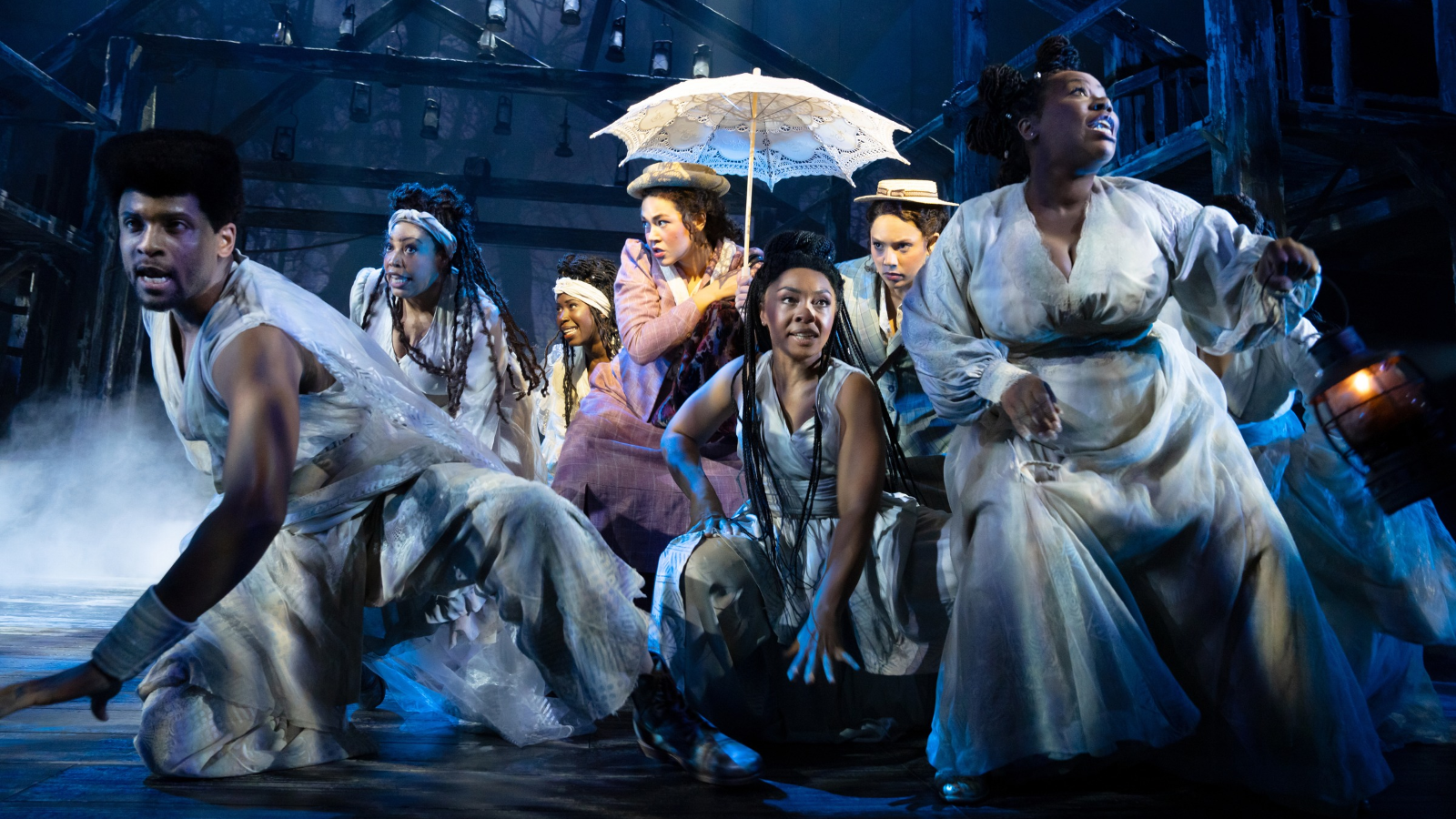
Chéri and Baum paper over the cracks by leaning excessively on a chorus of Kinfolk, led powerfully by a roof-shattering Melody A. Betts and a magnificent Aaron Arnell Harrington. The vocal work of this six-person guiding ensemble is flawless, as is true of every single performer in this show’s powerful ensemble. But for all their soaring vocal pyrotechnics, the Kindfook mostly feel like an unwanted distraction from Mary and Martha. It starts to feel like these sisters are not in charge of their own story.
The Kinfolk even frequently barge in to mock or make light of the latest twists in the Clarke sisters tale, one part of a tonal mishmash that director Stevie Walker Webb cannot reconcile. Struggling to make sense of all this mess, Webb, music director Paul Byssainthe Jr. and sound designer Gareth Owens seemingly aim to overpower our senses with a pounding sound balance that frequently overwhelms Cheri’s lyrics. One yearns for this excitable and overamplified musical to slow down, calm down, and remember why its central story was worth telling.
Wanted is now in performance on Broadway at the James Earl Jones Theatre on West 48th Street. For tickets and more information, visit here.


