


An Excellent DOWNSTATE Has Moved To Broadway — Review
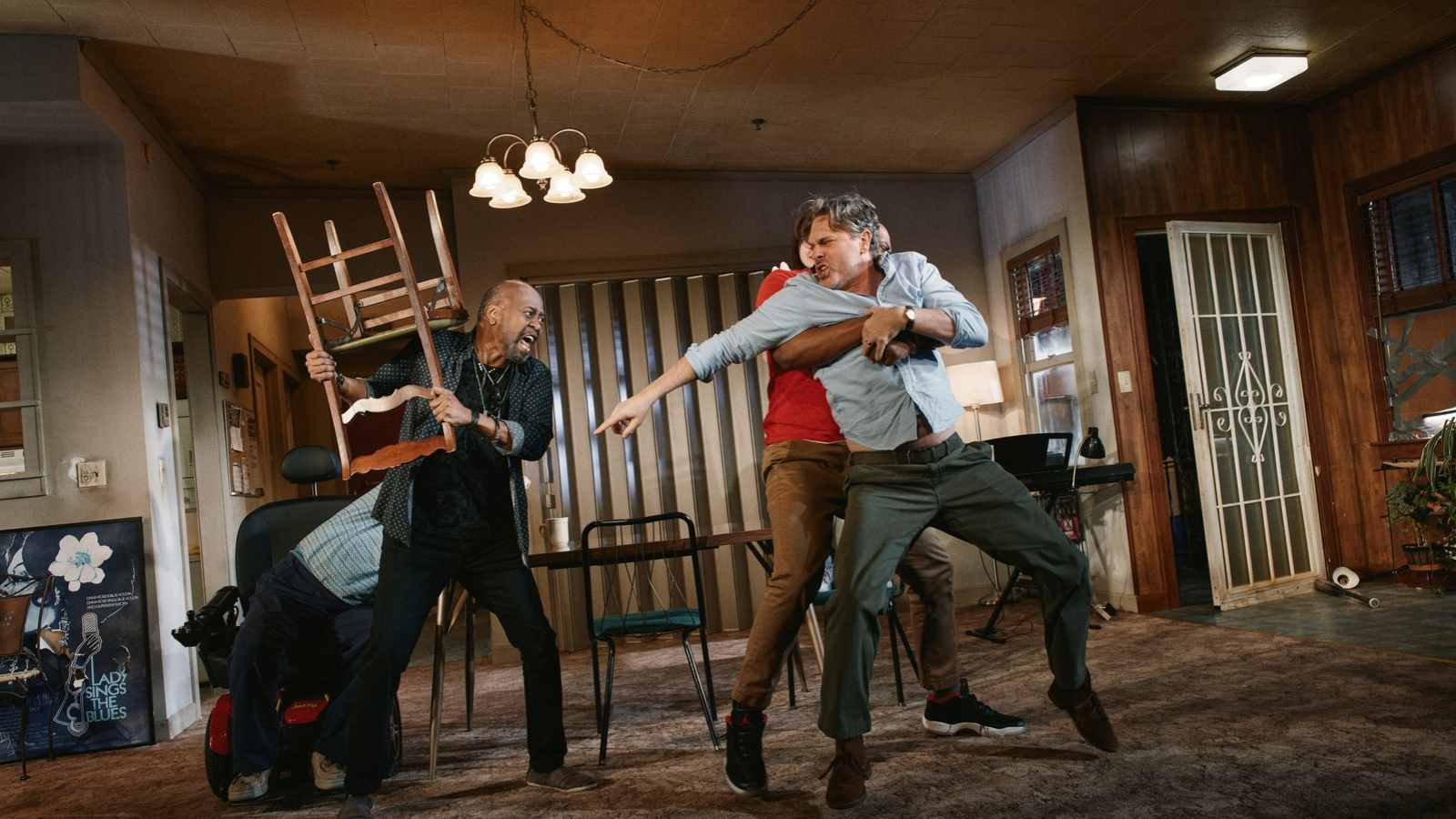
Girding my loins at intermission for the harrowing second act of Downstate, my gaze shifted upwards to a disquieting extra detail in the production’s scenic design.
Set in a halfway house for post-incarcerated sex offenders, Downstate centers on four men convicted of sexual crimes against children. The crumbling single-story home they share is shabby, and suffocating. This was equally true in the Off-Broadway premiere of Bruce Norris’ harrowing play, which ran at Playwrights Horizons in 2022 under the direction of Pam MacKinnon.
But for the play’s Broadway staging, opening tonight at the Booth Theatre, designer Scott Pask and director Joe Mantello have gone one step further with a frightening backdrop. (The Off-Broadway set, otherwise recreated quite closely, was by Todd Rosenthal.) Looming above the house is a black wall of concrete, obscuring our view of the outside world. And scrawled onto that wall are a mess of tally marks, chalk lines typical of a prison cell, counting the endless days of confinement as they go on and on.
Prisons both literal and psychological trap all the inhabitants of Norris’ play, and that central theme of confinement is acute under Mantello’s sharp direction. Everyone on stage—whether predator, victim or state actor—is in some manner locked away, whether the prison is one of deep denial, desperate performance or an unending trauma cycle.
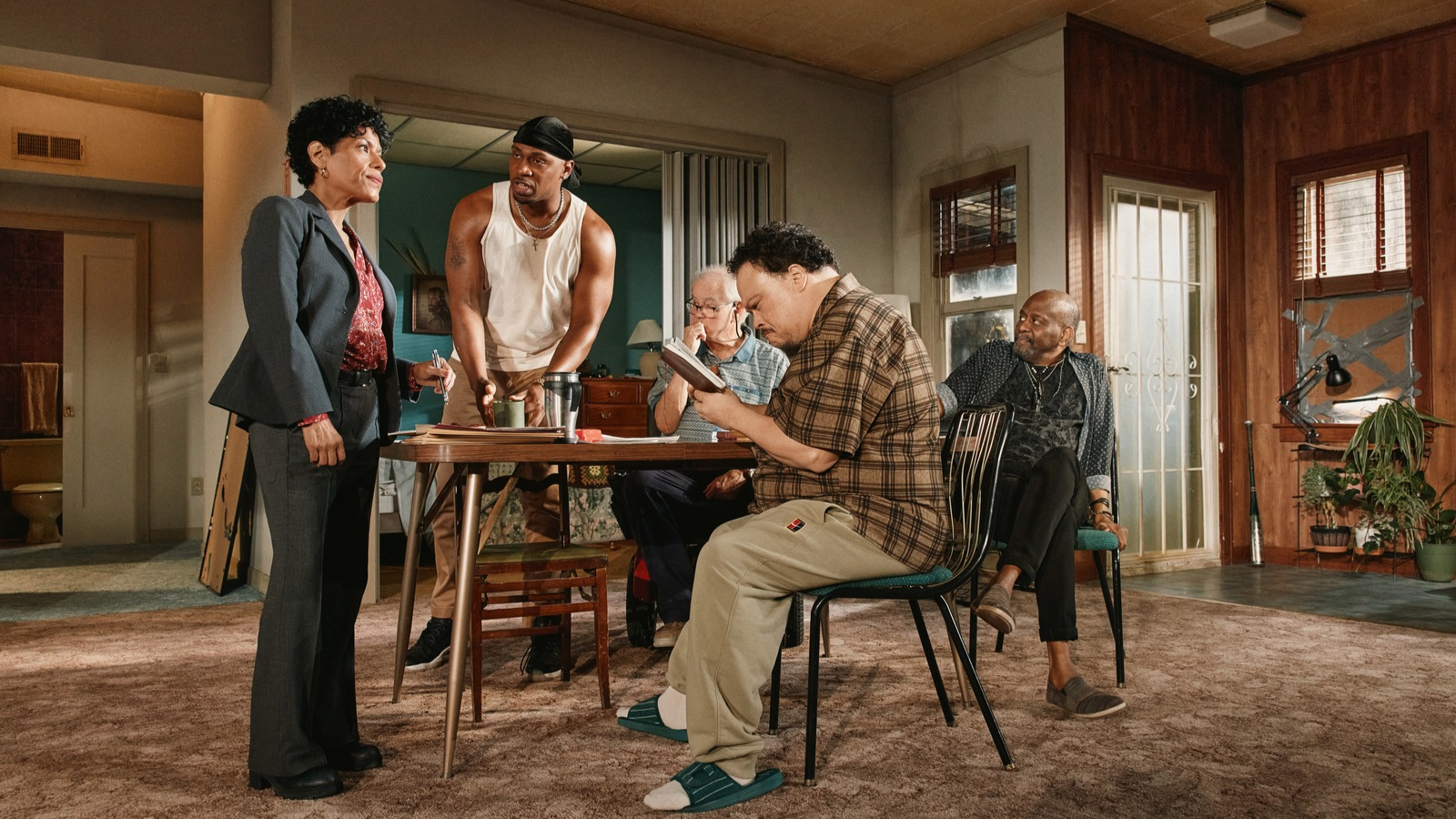
Of course, these four ex-convicts are no longer incarcerated in a technical sense. But good luck telling them that. Cell phones are forbidden for all four men, as is internet access. Each is equipped with an ankle bracelet. And as their parole officer Officer Ivy Delgado (Liza Colón-Zayas) notifies them during her weekly check-in, the protected perimeter around a nearby school has just been expanded to include their local IGA.
“Well that’s just silly,” sighs the outwardly sweet, doddering Fred (Frances Guinan), while his de-facto caretaker Dee (K. Todd Freeman), a master of rage-baiting snark, sets off monologuing on the geographic absurdities of the new map.
“That’s an overly broad piece of legislation,” protests Gio (Al’Jaleel McGhee), who insists his crime of statutory rape should not be held legally equally with those of his housemates. The more reserved Felix (Adrian Martinez) says litttle to nothing at all.
Delgado’s answer: “Nobody wants y’all livin’ anywhere. Be thankful ya got a roof over your head in the first place.”
In truth, Delgado shares the men’s exhaustion with a bureaucracy that frequently pains her as much as it traps them. But that shared frustration does not extend so far as empathy. She knows too much about these men, too many details of their heinous, unforgivable crimes.
Norris’ play, which premiered at Chicago’s Steppenwolf Theatre in 2018, invites its audience to confront that same dilemma: How far can empathy go? These four men are fully fleshed-out human beings, complicated and often sympathetic. Yet there is no question, particularly under Mantello’s directorial hand, that they are also monsters. Faced with these dual realities, how do we receive these people as individuals? And what should society do with them?
More so than in MacKinnon’s staging four years ago, I felt the monstrousness of central duo Fred and Dre with crystal clarity here. This is not to say Guinan and Freeman, who have played these roles to painful perfection across four stagings. do not find careful nuance in the men. But at the Booth, the pair’s respective brands of self-justifying bullshit are put on an unforgiving trial, and both men gradually crumble before our eyes.
An excellent McGhee brings similarly clear definition to Gio, whose try-hard fixation on rebranding himself as an entrepreneur (product “yet to be determined”) feels even timelier today. At times, Gio sounds like he is reciting AI-generated prompts as he zealously pitches his nonsense plans. And though McGhee never overplays the desperation under this performance, we always feel it.
The play’s driving narrative is set off by the arrival of Andy (Thomas Sadoski), one of Fred’s two victims, who has tracked him down in search of…closure? Retribution? Some form of resolution? Norris’ key observation, a brutal one, is that the catharsis Andy is seeking can perhaps never be provided, least of all by his abuser. The pursuit instead traps them both in a cruel, endless cycle. That Norris can make this thorny observation without denigrating the experience of survivors is the play’s greatest feat of tightrope walking.
Walking that knife’s edge requires a performer up to the task, and Sadoski is delivering one of the most extraordinary performances I’ve ever witnessed on stage. His Andy toggles between fervent rage, infantile stuntedness and agonizing dissociation. Most cruel of all is that seems at ease with Fred and Dee in a way he, evidently, cannot find elsewhere in his life. It is like Andy feels more himself with these men. And while we know that is not the truth of it, Andy is trapped in another reality, one where only his abusers can truly understand him.
The unforgiving eye of Mantello does have its downsides, as two of the play’s women have become needless caricatures along the way. Certainly Andy’s wife, Em, is intended to Norris to be annoying—but she need not be a shrill, Karen-ified cartoon, as the (usually excellent) Cassie Beck is playing her. At Playwrights, Sally Murphy framed Em’s intensity as arising from a place of last resort, pure desperation that this ill-advised visit might somehow rescue the man she loves from doom.
And while Gio’s possibly underage girlfriend Effie has never exactly been a subtle figure in the play, there is no humanity to be found in Ivy Wolk’s ridiculously over the top theatrics. (At my performance, the excellent Colon-Zayas seemed hesitant and stumbled over lines, sapping the energy out of two key scenes. But she is the G.O.A.T, so, I wish to simply forgive and forget.)
Downstate is a work that requires incredible care of handling and delivery to hit home. Brought to life correctly, as it mostly is in this riveting new Broadway staging, it lands like a sledgehammer. The loss of a female guiding hand is felt in some areas, but this is nonetheless a terrific production of a play that, for all its provocations, finds empathy everywhere while never looking away from horror.
Downstate is now in performance on Broadway at the Booth Theatre on West 45th Street in New York City. For tickets and more information, visit here.


